What is the Camino Story?
Bien Camino! There are many resources on the history of the Camino de Santiago or The Way of St. James, but for those of you following me that have never heard of the Camino, I just want to give a brief overview so you feel oriented to the journey my friends and I are embarking on.
The Camino de Santiago and more specifically the Camino Frances crosses Northern Spain from Saint-Jean-Pied-de-Port France 485 miles to Santiago de Compostela and is one of many different routes established for pilgrims to make their way to the remains of the apostle St. James.*
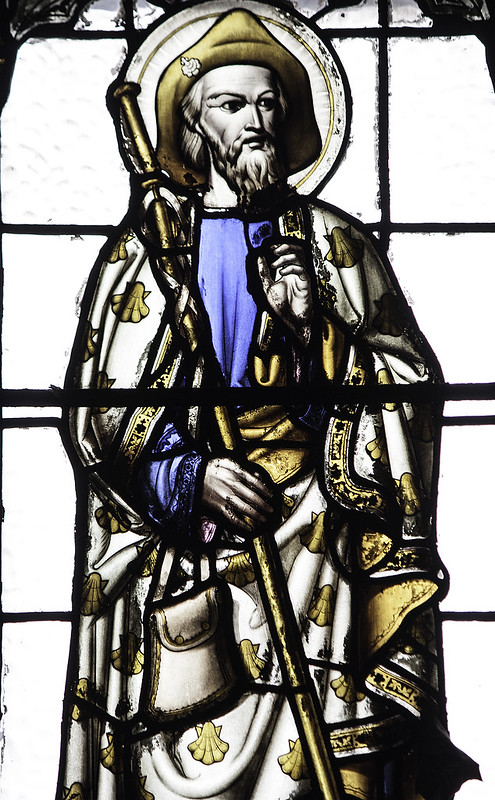
After Jesus was crucified, St. James made his way to the Iberian peninsula in hopes of converting people to Christianity. He wasn’t successful- accounts say he got seven converts. He then headed back to Jerusalem where King Herrod had him beheaded in AD44. Santiago’s friends took his body and placed it on a stone boat- no sails, no oars, no crew and directed it to head for Northwest Spain. A week later, he arrived in Padròn where his disciples were waiting for him and he was buried in Compostela.
Over the next few centuries, Santiago was mostly forgotten while the people of Spain turned increasingly to Christianity until the 8th century when Muslim armies arrived from North Africa and conquered much of Spain and even moved into France, though pockets of Christianity still remained. Then in 813 AD, a Christian hermit followed sweet music under the sweeping starry sky to a hillside in Galicia where St. Jame’s bones were recovered and verified.
The King of Asturias, Alfonso II, built a chapel to house his remains and then declared Santiago the patron saint of Spain. His legend spread across Spain and stories abounded as he was purported to be instrumental in the fight against the Muslims. He was revered for that and in addition to the peaceful image as one of the original pilgrims (Santiago Peregrino) he was also called Santiago Matamoros (Moor Slayer).
Outside of Christianity, and long before Santiago, the ancient Celts walked this route following the Milky Way through Northern Spain to the sea at Finnisterre, which to them was the end of the world and as far to the west as they could walk. From ancient times to the present, the Camino Frances is seen by many as a “thin space”- a place where you feel nearer to God.
From ancient times to the present, the Camino Frances is seen by many as a “thin space”- a place where you feel nearer to God.
-Rebecca lampman
Over the centuries the Camino has been used as a way by church authorities to keep the Muslims at bay, and from mediaeval times to present, the Camino has served as a source of cash flow and economic opportunity for the region due to the steady stream of pilgrims who need food, shelter and supplies for their journey. For the faithful, it is a way to avoid purgatory and in the past criminals could be ordered to walk the Camino as penitence.
After the 11th and 12th centuries when the numbers of pilgrims peaked, there was a steady decline in pilgrims and by the mid-20th century very few people made the pilgrimage. This changed in the 1960s, when a parish priest named Don Elias Valiña Sampedro wrote the first modern day guidebook and in the 1980s the popularity of the trail soared. Pope John Paul II visited Santiago de Compostela and the EU declared the camino to be Europe’s first Cultural Itinerary. In 1993, UNESCO added the camino to its World Heritage list.
Today, the Camino is walked by people from all over the world for many different reasons and from all different faiths. Some walk for the physical challenge. Some participate in the walk as a part of the movement towards “slow tourism”. Others walk for spiritual benefits and their faith. Still others walk for the adventure and to meet others from all around the world. Some people are drawn to walk during difficult periods in their lives or during periods of transition.
Why would you want to make the pilgrimage?
*My information on the history of the Camino Frances comes from the guidebook Walking the Camino de Santiago 3rd edition by Bethan Davies and Ben Cole. Photo of St. James by OP Lawrence.
 It is Solved By Walking- St. Augustine
Why do I want to go, you ask? Because its a great physical and spiritual exercise that is going to take place OUTSIDE of the USA! Also, The story of St. James is intriguing.
>
LikeLiked by 1 person
Perfect! Yes the story of St. James is intriguing and I am so looking forward to learning also about the foods and natural history and the culture of the area as well!
LikeLiked by 1 person